Information checked October 20, 2026. Statement layouts, minimum-payment formulas, APRs, fees, payment cutoffs, grace periods, and dispute procedures vary by issuer and account. Use the figures below only as examples and follow the terms shown on your own statement and cardholder agreement.
 |
| Start with the statement balance, minimum payment, due date, and APR before reviewing every transaction. |
When I first looked at a U.S. credit-card statement, I could guess that “minimum payment” meant the smallest amount I had to pay. The other numbers were less obvious. I did not clearly understand why the current balance and statement balance were different, and the APR looked important without explaining what I should do with it.
We usually made our credit-card payments manually rather than relying on AutoPay. We did not incur a late fee, so this is not a story about recovering from a missed payment. It is about the uncertainty that comes before payment: which amount should I choose, which date matters, and does APR apply even if I pay the card?
The app and the monthly statement answer different questions
A card app is a live account view. It may display recent purchases, pending transactions, a current balance, available credit, and a payment button. A monthly statement is a record of one completed billing cycle. It freezes the activity through the closing date and identifies the payment connected to that cycle.
This timing difference explains why two correct screens can show different totals. A purchase made after the statement closed may appear in the app’s current balance but not in the statement balance that is due for the completed cycle.
The balance an issuer reports can also affect credit utilization. Our U.S. credit-score guide for newcomers explains why utilization, reporting timing, and the score shown in a bank app are not the same thing.
If your first card has a small limit, read our guide to using a first $500 credit limit. That article explains how a modest purchase can consume a large share of available credit. This guide focuses on what happens when the billing cycle closes and the statement arrives.
A fictional $500-limit statement example
Consider this invented account. It is not copied from our personal statement and does not represent any issuer’s exact minimum-payment formula.
| Item | Example | What it means |
|---|---|---|
| Credit limit | $500.00 | The issuer’s current maximum credit line. |
| Statement closing date | October 20 | The last day included in this billing cycle. |
| Statement balance | $86.40 | The balance recorded when this cycle closed. |
| Minimum payment | $25.00 | The example issuer’s smallest required payment for this statement. |
| Payment due date | November 15 | The issuer must receive the required payment by the stated cutoff. |
| Current balance in the app | $112.15 | The $86.40 statement balance plus $25.75 in newer posted activity. |
| Purchase APR | 29.99% | An example annualized rate for purchase balances; it is not a monthly charge of 29.99%. |
In this example, paying $25 by November 15 would satisfy the stated minimum, but $61.40 of the statement balance would remain. Paying $86.40 by the due date would pay the complete statement balance. If the account has a purchase grace period and no carried balance, that full statement payment generally avoids interest on the purchases covered by the statement. Paying the $112.15 current balance would also cover the newer posted activity, but the extra $25.75 was not part of the October 20 statement.
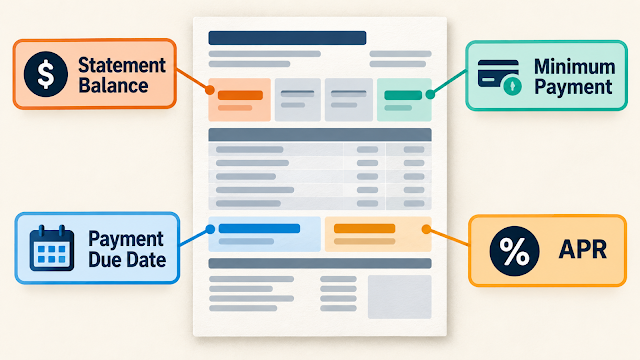 |
| These four fields answer different questions: how much the cycle ended with, the smallest required payment, the deadline, and the borrowing rate. |
1. Statement balance: the completed cycle’s total
The statement balance—sometimes labeled “new balance”—is the amount recorded at the end of the billing cycle. It is built from the previous balance, new purchases, fees, interest, payments, refunds, and other credits that posted during that period.
Do not assume every statement balance consists only of shopping. Read the account-summary equation:
If those pieces do not reconcile, inspect the transaction and fee sections rather than relying only on the large total at the top.
2. Current balance: activity after the statement closed
The current balance is a live number and may include posted purchases made after the closing date. It can also change when a payment or refund posts. Pending transactions may affect available credit even before they appear in the posted balance, depending on the issuer.
For a closer look at the processing stage, see why pending charges can reduce available credit before they enter the current balance and why payments do not always restore spending room immediately.
This is the point that would have helped me most: current balance answers “what is posted now?” while statement balance answers “what did the completed cycle end with?” The current balance is not automatically the amount that must be paid to satisfy the last statement.
3. Minimum payment: required does not mean interest-free
The minimum payment is the smallest amount the issuer requires for that statement. The issuer’s formula may include a fixed floor, a percentage of the balance, interest, fees, past-due amounts, or other terms. Do not copy the $25 figure in the fictional example; read the amount printed on your own statement.
Paying at least the minimum on time is important, but it does not normally erase the rest of the statement balance. If you pay only the minimum, the remaining balance can continue into later cycles and may accrue interest. The CFPB warns that minimum-only payments can take years to eliminate.
U.S. statements generally include a Minimum Payment Warning. It estimates how long repayment may take and the total amount paid if you make no additional purchases and pay only the minimum. It may also show the monthly amount estimated to repay that balance in about three years. That three-year figure is an illustration, not an additional mandatory payment.
4. Payment due date: the payment must arrive on time
The due date is the deadline for the required payment. The CFPB explains that an issuer generally cannot treat a payment as late when it is received by 5 p.m. on the due date in the time zone stated on the bill, although reasonable online or in-person cutoff rules can apply. A payment sent on the due date is not necessarily a payment received on the due date.
For manual payments, a safer routine is:
- Open the official issuer app or website several days before the deadline.
- Confirm which bank account will fund the payment.
- Select the intended amount: minimum, statement balance, current balance, or another amount.
- Review the delivery date shown before confirming.
- Save the confirmation number without exposing account information.
- Return after processing and verify that the payment posted.
Paying manually is not wrong. It simply requires an active reminder and a final check. If you have not connected the funding account yet, our U.S. bank-account guide for newcomers explains routing numbers, external transfers, and account setup questions.
5. APR: the annualized cost of carrying certain balances
APR means annual percentage rate. It is an annualized rate used to describe the cost of borrowing; it does not mean the issuer charges the full APR percentage once every month. Your card may list different APRs for purchases, balance transfers, cash advances, or a penalty rate.
The CFPB explains that many issuers calculate interest daily using an average daily balance. A daily periodic rate is commonly derived from the APR, and new purchases, payments, and credits can change the daily balances used in the calculation. That is why the statement includes an interest-charge calculation section rather than multiplying one month-end number by the APR.
If your card provides a grace period for purchases and you are not already carrying a balance, paying the full statement balance by the due date can allow you to avoid interest on those purchases. Not every card is required to offer a grace period, and cash advances generally do not receive the same treatment. Read the agreement instead of assuming that every transaction is interest-free until the due date.
6. Transactions, payments, and credits
Review the activity line by line. For each purchase, check the transaction or posting date, merchant description, location or reference information, and amount. A merchant name on the statement may differ from the storefront name, so investigate an unfamiliar description before deciding that it is fraud.
A repeating digital charge may belong to a subscription managed through a different platform. Our forgotten-subscription checklist explains how to trace the statement description to the correct account and cancellation screen.
Payments should appear as credits to the account. Refunds and statement credits also reduce the balance, but their labels and posting dates can differ. A store approving a refund does not mean the card issuer has already posted it. Our guide to returns and refunds at U.S. stores explains why the retailer and the card account may show different stages of the same refund.
7. Fees and interest charged this period
A separate section should identify fees and interest added during the cycle. Possible entries include an annual fee, late fee, returned-payment fee, balance-transfer fee, cash-advance fee, or foreign-transaction fee. Whether a fee exists and how it is calculated depend on the agreement.
We did not receive a late fee, so this article does not claim firsthand experience disputing one. If a fee appears, trace it to the event and date that triggered it, then compare the charge with the agreement. Contact the issuer promptly if the reason is unclear.
8. Notices and changes to account terms
Do not ignore the small notices simply because the payment box looks correct. The statement may announce an APR change, fee change, revised payment address, expiring promotion, or other account term. Promotional APRs can have end dates, and different balances on the same account may be subject to different rates.
Save statements in a secure location long enough to reconcile purchases, refunds, disputes, taxes when relevant, and any continuing payment plan. Do not post a statement publicly or upload it without removing your name, address, account number, barcode, QR code, and transaction details.
What to do when a charge looks wrong
Call the issuer using the number on the back of the card or the official statement and report the problem promptly. The CFPB also explains that, to protect federal billing-error rights, a written billing-error notice generally must reach the card company within 60 calendar days after the charge first appeared on the statement. The statement should provide the correct billing-dispute address, which may differ from the payment address.
Keep copies of the notice and supporting documents. Continue paying the correct, undisputed charges on time. A store refund request, a fraud report, and a formal billing-error notice may follow different processes, so ask the issuer which procedure applies rather than selecting a random dispute category.
A five-minute statement review
- Confirm the cycle. Note the opening and closing dates.
- Read the payment box. Mark the statement balance, minimum payment, and due date.
- Compare balances. Explain any difference between the statement balance and current balance.
- Check every transaction. Match purchases, payments, refunds, and credits.
- Inspect fees and interest. Do not assume APR created a charge without checking the grace-period and balance history.
- Read notices. Look for changes to rates, fees, promotions, or account terms.
- Schedule the payment. Choose the amount intentionally and verify the delivery date.
- Confirm posting. Reopen the account after processing and check the result.
This is what I would do differently now: I would not open the app and immediately press the first payment option I recognized. I would write down four lines—statement balance, minimum payment, due date, and purchase APR—then compare the statement balance with the current balance. That simple order turns a page full of numbers into a decision.
Frequently asked questions
Which amount should I pay to avoid interest?
If the card offers a grace period for purchases and you are not already carrying a balance, paying the full statement balance by the due date generally avoids interest on eligible purchases. Cash advances, balance transfers, and an account that has lost its grace period may follow different rules.
Why is my current balance higher than my statement balance?
You may have made purchases after the statement closing date. Those newer transactions can appear in the current balance even though they were not part of the completed statement cycle.
Does paying the minimum payment avoid interest?
Not necessarily. It can satisfy the required minimum when received on time, but the unpaid portion may carry forward and accrue interest. Read the statement’s interest and grace-period terms.
Does APR matter if I pay the statement balance in full?
It still matters because it describes borrowing cost if a balance becomes subject to interest. With an applicable purchase grace period and no carried balance, paying the full statement balance on time can generally avoid purchase interest.
Should I use AutoPay instead of paying manually?
Either method can work. AutoPay may reduce the chance of forgetting, but you still need enough money in the funding account and should verify that the payment processed. Manual payment offers control but requires reminders and confirmation. Choose the method you can monitor reliably.
Before enabling it, read our guide to AutoPay, recurring payments, and auto-renewal. Turning off an automatic payment does not necessarily cancel the underlying service or subscription.
Official sources
- CFPB: Sample credit card statement
- CFPB: Minimum payment and three-year payoff disclosure
- CFPB: Credit-card grace periods
- CFPB: How credit-card interest is calculated
- CFPB: When a credit-card payment is considered late
- CFPB: How to dispute a credit-card charge
- CFPB: How to fix mistakes in a credit-card bill
- CFPB: Credit-card contract definitions
This article provides general educational information, not individualized financial, credit, legal, or tax advice. Your statement, agreement, payment status, and applicable law control your account.