Information checked November 2, 2026. Pending-transaction and payment-processing practices vary by card issuer, merchant, payment network, transaction type, and account history. Check your own issuer’s app, agreement, and customer-service guidance.
 |
| A lower available-credit number does not always mean that a new charge has already posted to the account balance |
When I first used a U.S. credit card, I noticed that my available credit could suddenly become smaller. I eventually realized that pending purchases were probably reserving part of the credit line. What made the screen harder to understand was that the current balance did not always change at the same time.
I was also surprised when a displayed amount became larger than I expected. At first, I wondered whether a large amount of sales tax had been added. Tax can make a final purchase total higher than a shelf price, but it is not the only explanation for a changing card amount. A merchant may first request a temporary authorization and later submit a different final amount.
Available credit is not the same as your current balance
Your credit limit is the maximum credit line the issuer has currently provided. Your available credit is the portion that remains usable after the issuer accounts for posted balances, pending authorizations, holds, and any other applicable account adjustments.
Your current balance generally reflects transactions that have posted, along with posted payments, credits, fees, and other account activity. A pending purchase may already reduce available credit even though it is not yet included in that posted balance. Exact labels and calculations vary by issuer, so the numbers may not fit a simple subtraction at every moment.
| App term | What it usually tells you | Important limitation |
|---|---|---|
| Credit limit | The maximum line currently assigned to the account | It is not extra income or a recommended spending amount. |
| Available credit | How much of the line the issuer currently shows as usable | Pending charges and holds may reduce it before they join the posted balance. |
| Current balance | The live total of activity that has posted to the account | It is not necessarily the amount required to satisfy the last statement. |
| Statement balance | The balance recorded when the completed billing cycle closed | Later purchases may appear in the current balance but not this closed-cycle amount. |
For a complete explanation of the monthly bill and payment choices, use our U.S. credit-card statement guide. This article focuses on what happens before a purchase or payment finishes processing.
How a pending charge can lower available credit first
When you make a card purchase, the merchant normally asks the issuer to authorize it. The issuer checks whether the account is valid and whether enough credit is available. If the transaction is approved, the issuer may reserve that amount while the merchant finishes processing it.
Capital One explains that a pending authorization places a hold on available credit until it processes. Chase similarly notes that a pending amount will likely be subtracted from available credit even though it has not yet been added to the account balance. These are issuer explanations, not promises that every card app displays transactions in exactly the same way.
Consider a fictional card with a $1,000 limit:
| Account activity | Current balance | Pending activity | Available credit |
|---|---|---|---|
| Before a new purchase | $200 posted | $0 | About $800 |
| After a $75 authorization | May still show $200 | $75 pending | May fall to about $725 |
| After the $75 posts | About $275 | $0 for that purchase | About $725 |
The $75 should not permanently count twice. It moves from pending activity to posted activity after the merchant completes the transaction. During processing, however, the app can look confusing because the available-credit calculation has already changed while the displayed current balance has not.
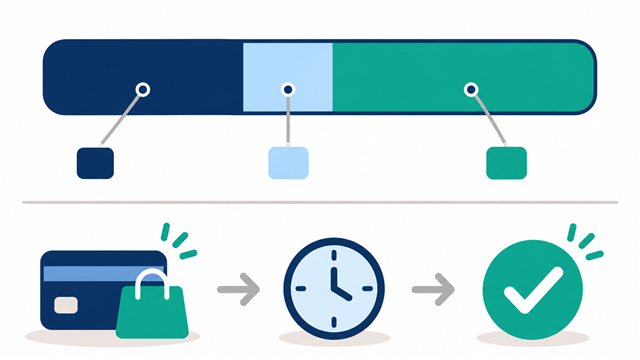 |
| A pending authorization can reserve part of the credit line before the final purchase becomes a posted balance. |
Why the pending amount may differ from the final charge
A pending amount is not always the merchant’s final request. The merchant may not yet know the exact total, or the transaction may require an adjustment before settlement.
- Restaurants: an initial authorization may be adjusted when the merchant includes the tip.
- Gas stations: paying at the pump can begin with a temporary authorization before the exact fuel total is known.
- Hotels and rental cars: the merchant may authorize an estimated amount that includes room, rental, deposit, or incidental coverage.
- Online orders: a merchant may wait to finalize the charge until an item ships, or may process parts of an order separately.
- Canceled purchases: an authorization can remain visible temporarily even when it later disappears without becoming a final charge.
Restaurant transactions can be especially confusing when a tip is added after the first card authorization. Our guide to U.S. tip screens, suggested percentages, and service charges explains what to review before approving the final amount.
Gas pumps are a common place to see this sequence. Our guide to gas-station card holds and paying at the pump explains preauthorization, debit versus credit, inside prepayment, ZIP prompts, and the Costco membership step.
Capital One identifies restaurant tips, fuel-pump authorization amounts, and hotel or rental-car incidental estimates as reasons a pending amount may change. The safest response is not to guess that every increase is tax. Compare the final receipt with the posted transaction after processing finishes.
If the confusion began because a store’s displayed price was lower than the checkout total, read our guide to why U.S. checkout prices can be higher than expected. That guide explains sales tax and other checkout conditions; a card authorization hold is a different stage of the payment process.
Why available credit may not return immediately after a payment
I have made a payment and waited because the account did not appear to update immediately. At other times, the available-credit number increased quickly enough that I thought I could use the card again. Both experiences can occur, but an early increase should not be treated as a universal promise that every payment has fully cleared.
Bank of America’s current payment FAQ says account balances and funds availability can take up to two bank business days to update. Capital One describes a payment hold as a period in which the issuer confirms a payment from the linked bank account before restoring available credit; its published example says such a hold can sometimes last several days. Your issuer’s timing may be different.
A card payment has at least two timing questions:
- Was the payment received on time? This matters for the due date and potential late-payment consequences.
- Has the issuer restored the credit line? This determines how much the app currently shows as available for another purchase.
Those events may not occur at the same moment. Do not submit a duplicate payment merely because the available-credit number has not yet changed. First review the payment status and confirmation, then follow the issuer’s stated processing timeline.
What to check when the numbers look wrong
- Confirm the account. Make sure you are looking at the correct card, especially if two cards appear in the same banking app.
- Separate pending from posted activity. Add the pending authorizations and compare them with the change in available credit.
- Open the transaction details. Look for the merchant name, date, status, and any explanation of a temporary hold.
- Save the receipt or order confirmation. Use it to compare the expected final total after the transaction posts.
- Check recent payment status. Verify whether it is scheduled, processing, completed, returned, or subject to a hold.
- Allow the published processing period. Weekends, holidays, merchant timing, and issuer procedures can affect posting.
- Contact the right party. Ask the merchant about an expected authorization or incorrect final amount; ask the issuer about the account display, an unexplained hold, or an unfamiliar transaction.
A safer habit for a small first credit limit
Pending authorizations matter more when the credit limit is small. A $150 hold uses 30 percent of a $500 limit but only 3 percent of a $5,000 limit. The hold is the same dollar amount, yet the first cardholder loses a much larger share of usable credit.
Our guide to managing a first $500 credit limit explains why a small starting line requires extra room for pending purchases and why carrying a balance is not necessary for building credit.
- Treat an authorized pending purchase as already spent.
- Leave room for tips, deposits, or estimated authorizations when applicable.
- Do not rely on a payment to restore credit instantly.
- Keep a backup payment method for essential purchases.
- Pay according to the statement balance and due date, not merely because the card is close to its limit.
What I understand differently now
When available credit first dropped, I treated the mismatch as if one of the numbers had to be wrong. I now read the screen in a sequence: credit limit, posted current balance, pending transactions, recent payments, and then available credit.
I would also avoid explaining every larger amount as sales tax. I would first ask whether I was viewing an estimated authorization, a tip adjustment, a merchant hold, or a final posted charge. Then I would compare the posted amount with the receipt rather than assuming the pending screen was the final bill.
Frequently asked questions
Why did my available credit decrease when my balance did not change?
A pending authorization may have reserved part of your credit line before the purchase joined the posted current balance. Open the pending-transaction list and review the issuer’s calculation.
Will a pending charge be added twice?
A normal transaction should move from pending to posted rather than remain as two permanent charges. The displays can briefly look confusing during processing. If both amounts remain after the expected timeframe or the final total is wrong, contact the merchant and issuer.
Why is the final restaurant, gas-station, or hotel charge different?
The first amount may have been an estimate or authorization. A tip, actual fuel total, incidental amount, deposit adjustment, or other finalized charge can change the posted amount. Compare it with the receipt and merchant terms.
Does paying my card immediately restore available credit?
Sometimes the app updates quickly, but not always. The issuer may wait for the payment to process or clear before restoring the line. Check the payment status and the issuer’s published timing instead of depending on immediate availability.
Should I make another payment if the first one is still processing?
Not automatically. Confirm that the first payment was scheduled or received, verify the source account, and follow the issuer’s instructions. An unnecessary duplicate payment can create a different cash-flow problem.
Sources and further reading
- Consumer Financial Protection Bureau: What a credit-card authorization means
- Consumer Financial Protection Bureau: When a credit-card payment is considered late
- Capital One: Understanding pending credit-card transactions
- Capital One: Understanding a payment hold
- Chase: Pending credit-card transactions
- Bank of America: Credit-card payments and statements FAQ
This article provides general educational information, not individualized financial or legal advice. Card terms, holds, processing times, and dispute procedures vary. Verify instructions with your own card issuer and merchant.