 |
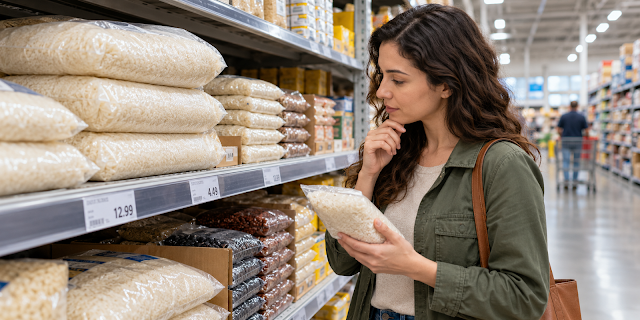
A larger package is not automatically the better value—compare the unit price using the same measurement. |
When our household shopped at Costco, we sometimes assumed that the larger package had to be the cheaper choice. The total price was higher, but we thought buying in bulk automatically meant paying less for each ounce or item.
U.S. grocery labels made that comparison harder at first. We understood ea to mean “each,” but terms such as unit price, per oz, and per lb were easy to overlook. We also thought ounces were mainly used for drinks. Later, we learned that oz commonly measures weight, while fl oz measures liquid volume.
The large number on a shelf tag tells you what you will pay for the package. The smaller unit price helps you compare differently sized packages. Those two numbers answer different questions—and the largest package is not always the best value.
What is the difference between retail price and unit price?
A typical U.S. shelf label can show several pieces of information:
- Product description: the brand, variety, and package size;
- Retail price, “You Pay,” or item price: the price of the entire package;
- Unit price: the cost for one standard amount, such as one ounce, pound, fluid ounce, or item;
- Sale or member price: a temporary price that may require a loyalty account, coupon, or quantity; and
- Dates or store codes: information that may be useful to the retailer but is not the price you pay.
The National Institute of Standards and Technology defines unit pricing as the cost per unit of measure—for example, the cost per ounce. Its current best-practice guide recommends identifying the retail price and unit price clearly and using consistent units within a product category. Actual label designs and legal requirements can still vary by store and state.
How to read a shelf label in three steps
- Match the label to the product. Check the description, flavor, count, and package size. A tag can belong to the item beside the one you picked up.
- Find the package price. This is usually the largest number and may be labeled retail price or “You Pay.”
- Find the unit price and its unit. Do not compare the number until you know whether it means per ounce, per pound, per fluid ounce, or per each.
For example, a shelf label might show:
Retail price: $3.99
Unit price: 33.3¢ per oz
You pay $3.99 for the box. The 33.3-cent figure is there so you can compare that box with another size or brand.
What do oz, fl oz, lb, ea, and per unit mean?
| Abbreviation | Meaning | Common examples |
|---|---|---|
| oz | Ounce by weight | Cereal, rice, cheese, snacks, coffee |
| fl oz | Fluid ounce by volume | Juice, milk, soda, shampoo |
| lb | Pound by weight; 1 lb equals 16 oz | Meat, produce, bulk foods |
| ea | Each individual item | Avocados, rolls, single containers |
| ct | Count—the number of pieces in a package | Trash bags, coffee pods, eggs |
| per unit | A general rate for the unit named on the label | Per oz, per lb, per item, per sheet, or another stated unit |
The difference between oz and fl oz is especially important. An ounce measures weight; a fluid ounce measures volume. FDA household-measure guidance uses approximately 28 grams for one ounce and 30 milliliters for one fluid ounce in nutrition labeling. They are not interchangeable just because both contain the word “ounce.”
If a label simply says “per unit,” look for the unit printed beside or below the number. The “unit” is not always one whole package. It could be one ounce, one sheet, one load, one roll, or one individual item.
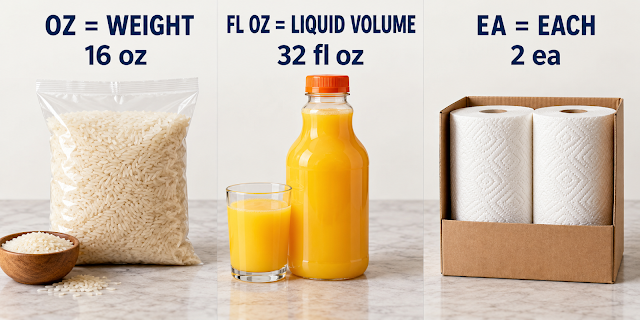 |
OZ measures weight, FL OZ measures liquid volume, and EA means each. |
How to calculate unit price yourself
If a shelf label does not show a unit price—or two labels use different formats—you can calculate it with your phone:
Suppose two bags of rice are the same type and quality:
- Bag A: $4.49 ÷ 18 oz = about 24.9¢ per oz
- Bag B: $7.20 ÷ 30 oz = 24¢ per oz
Bag B has the lower unit price, so it offers slightly more rice for each dollar. Bag A still costs less today and may be the better choice if you have limited storage or will not finish the larger bag.
When comparing pounds with ounces, convert them to the same unit first. Because one pound equals 16 ounces, a 2-pound package contains 32 ounces. Never compare “$3.20 per lb” directly with “25¢ per oz” until both rates use pounds or both use ounces.
Is a bigger package always cheaper?
No. A warehouse-size package can have a lower unit price, but it is not guaranteed. A smaller package may be on sale, a store brand may cost less, or a manufacturer may price two package sizes differently. The only reliable comparison is the unit price using the same unit of measure.
Our Costco assumption was understandable: large packages often look like the value option. But a bulk purchase creates three separate questions:
- Is the unit price actually lower?
- Can our household use or freeze the entire amount?
- Is the higher total price worth paying today?
A 40-roll package may be cheaper per roll but still be a poor purchase if you lack storage. A large container of food is not a bargain if part of it spoils. Unit price measures price efficiency; it does not measure convenience, quality, storage needs, or waste.
How sales and coupons change the comparison
A regular shelf label may show one unit price while a sale sign, member price, or digital coupon creates another. Before comparing products, confirm which price you actually qualify to receive.
Check for phrases such as:
- with card or member price;
- digital coupon;
- must buy two;
- mix and match;
- limit per household; or
- valid through a specific date.
NIST’s best-practice guide recommends displaying a unit price for regular, sale, club-card, and digital-coupon offers. Not every real-world sign will be equally easy to read, so calculate the discounted unit price yourself when necessary. Our guides explain how digital grocery coupons work and whether a “2 for $6” sale requires two items.
When two unit prices use different measurements
Sometimes similar products are difficult to compare because one label uses price per ounce and another uses price per pound, per count, or per 100 sheets. First make sure the products are truly comparable. Then convert one rate if possible.
- Per pound to per ounce: divide the per-pound price by 16.
- Per ounce to per pound: multiply the per-ounce price by 16.
- Multipack to per each: divide the package price by the number of items.
- Coupon price: subtract the valid discount before dividing by the package amount.
Do not force a comparison between products measured in ways that reflect different uses. Paper towels may be priced per sheet or per 100 square feet, and laundry detergent may be advertised per fluid ounce even though the number of usable loads also matters. The mathematically lowest number is not helpful unless the units describe comparable value.
What about meat, produce, and items sold by weight?
For packaged meat, the sign may show a price per pound while the package displays its own weight and total price. A $4.99-per-pound sign does not mean every tray costs $4.99. Read our separate guide to understand price per pound and the total meat package price.
Loose produce may be sold per pound or per each. Apples marked $1.49 per pound are weighed; an avocado marked $1.49 each costs that amount for one avocado. At self-checkout, the machine may ask you to select the produce and place it on the scale—or it may charge by count.
A 20-second comparison in the store
- Confirm that both shelf tags match the products in your hands.
- Check the full package price so you know today’s cost.
- Find the unit price on each tag.
- Make sure the units match.
- Confirm any loyalty, coupon, or quantity requirement.
- Choose based on value, storage, and how much your household will actually use.
“Is this the price for the whole package or per ounce?”
“Does this unit price include the sale?”
“Do I need a membership or digital coupon for this price?”
What if the shelf label looks wrong?
Check the product description, size, and barcode area before assuming there is an error. A shopper may return a product to the wrong shelf, or a sale tag may refer only to a particular flavor or size.
If the correct product scans at a different retail price, show the shelf label to an employee and keep the receipt. Retail-pricing laws and available remedies vary by state. Also remember that sales tax can make the checkout total higher than the shelf-price total even when the item itself scanned correctly.
Frequently asked questions
Does oz always mean a drink measurement?
No. Oz usually indicates weight and appears on solid or dry products such as cereal, rice, snacks, and cheese. Fl oz indicates fluid volume and commonly appears on drinks and other liquids.
What does ea mean on a price tag?
Ea means “each.” A price of $1.25 ea generally means $1.25 for one item. Check whether the product is sold individually or in a multipack.
Is unit price the amount I pay at checkout?
Usually not. The unit price is a comparison rate. The retail or “You Pay” price is generally the package price before applicable tax, deposits, or other charges.
Should I always buy the product with the lowest unit price?
No. Consider quality, ingredients, storage, spoilage, and your available budget. The lowest unit price saves money only when the product meets your needs and you use what you buy.
The bottom line
Read two numbers on a U.S. grocery tag: the retail price tells you the cost of the package, while the unit price helps you compare value. Then read the unit itself—oz, fl oz, lb, ea, or another measure.
This simple check can prevent the assumption we once made at Costco: that the largest package must automatically be the cheapest. For more help planning where to shop, see our guide to U.S. grocery-store types and our Aldi-versus-Walmart comparison.
Information checked October 6, 2026. Shelf-label formats, promotions, units, and retail-pricing requirements vary by product, retailer, state, and locality.