 |
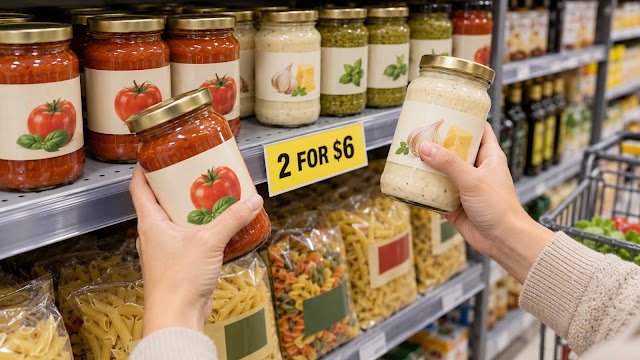
A “2 for $6” sign does not always tell you whether two are required—check the smaller terms. |
A grocery shelf tag that says “2 for $6” seems simple—until you start asking questions. Do you have to buy two? If you do, must they be the exact same item? Can you choose two different flavors?
In our household, we initially understood this kind of sign to mean that we had to buy both items. Then another question came up: did the deal require two identical products, or could we combine different varieties? That uncertainty is common because U.S. stores use similar-looking signs for promotions with very different rules.
The short answer is: sometimes one item receives the divided sale price, and sometimes the required quantity must be purchased. The small wording on the shelf tag or weekly ad decides which rule applies.
Does “2 for $6” mean you have to buy two?
Not always. Some stores divide a multi-item price automatically. Under that type of promotion, one item from a “2 for $6” offer would cost $3. A “10 for $10” item could cost $1 even if you buy only one.
For example, Kroger has advertised a 10-for-$10 event in which each participating item is $1 and shoppers may mix eligible items. White Haven Market’s published policy similarly says that one item in a 2-for-$5 promotion costs $2.50.
However, other promotions require the complete quantity. Look for phrases such as:
- Must buy 2
- When you buy 2
- Buy 2, save $2
- Buy 2, get 1 free
- Limit 2—which is a purchase limit, not necessarily a minimum
If the sign says “must buy 2,” buying only one may result in the regular price rather than half of the advertised total. Do not rely on the large number alone; the smaller line underneath often contains the condition that matters most.
What does “mix and match” mean?
Mix and match usually means you can combine different participating products to reach the required quantity. Depending on the promotion, that could include different flavors, sizes, or even different brands.
It does not automatically mean that everything on the same shelf qualifies. The eligible products might be identified by matching shelf tags, a promotional symbol, a list in the weekly ad, or a page in the store app.
 |
Matching shelf tags can help you identify which flavors or varieties are included in a mix-and-match deal. |
| Wording on the sign | What it usually means | What to check |
|---|---|---|
| 2 for $6 | One may be $3, but the store can require two. | Look for “must buy 2” in smaller print. |
| 2 for $6, must buy 2 | Two are required for the promotional price. | Check whether both items must be identical. |
| 2 for $6, mix & match | Eligible varieties may be combined. | Confirm which products carry the same promotion. |
| Buy 2, get 1 free | Usually three qualifying items are needed. | Check size, variety, loyalty, and coupon rules. |
| Limit 2 | You may buy no more than two at that price. | Do not confuse a maximum limit with a minimum purchase. |
Do the two items have to be exactly the same?
Only if the promotion says so or includes just one qualifying item. If several flavors or varieties display the same promotional tag, they may be eligible to mix. If the sign says “selected varieties,” some versions may qualify while others do not.
Imagine that three pasta sauces have matching “2 for $6—mix & match” tags. You may be able to choose one tomato-basil sauce and one garlic sauce. But a larger jar, organic version, or premium variety without the matching tag might not count.
A useful rule is to check four details:
- Brand: Does the promotion cover one brand or several?
- Size: Are both packages the required weight or count?
- Variety: Does the tag say “selected varieties” or “all varieties”?
- Promotion marker: Do both products have the same colored tag, event name, or app listing?
Kroger’s published mix-and-match events provide a useful example: its “Buy 5 and Save” promotion says shoppers may combine five or more participating items. The freedom to mix therefore applies within the event’s eligible product list, not to unrelated groceries.
How to read a multi-buy shelf tag
1. Read the line under the large price
The large “2 for $6” catches your attention, but the smaller print may say “must buy 2,” “with card,” “digital coupon,” or “selected varieties.” Read the entire tag before putting the product in your cart.
2. Check whether a loyalty account is required
A promotion may apply only after you enter the phone number connected to a store account or scan a loyalty card. If you are unsure why a cashier asks for your number, read our explanation of why U.S. stores ask for a phone number at checkout.
3. Look for a digital-coupon requirement
A shelf tag can show a digital-coupon price that is lower than the regular loyalty price. In that case, you may need to clip the offer before paying. Our beginner’s guide to digital grocery coupons explains the complete process.
4. Match the size and variety
A sale may cover only 12-ounce packages, certain flavors, or items marked with the same event symbol. Products that look almost identical can still have different promotional eligibility.
5. Use the store app or ask an employee
If the sign is unclear, scan the product in the store app, open the weekly ad, or ask an employee, “Do I need to buy two for this price?” You can also ask, “Can I mix different flavors?” Those two questions usually solve the confusion quickly.
“Do I have to buy two to get this price?”
“Can I mix and match different flavors?”
“Is this item included in the promotion?”
Four common examples
Example 1: “2 for $6” with no other visible condition
One item may cost $3. Before assuming, check the full tag, store app, or register display because store policies differ.
Example 2: “2 for $6—must buy 2”
Buy two qualifying items to receive the deal. If you buy only one, it may ring up at the regular price.
Example 3: “2 for $6—mix & match selected varieties”
You may be able to choose two different flavors or products included in the same event. Confirm that both carry the matching promotional marker.
Example 4: “Buy 2, get 1 free”
You generally need three qualifying items: two paid items and one free item. Publix, for example, states that promotions such as buy-two-get-two-free require shoppers to purchase the full number of products. Its BOGO rules also demonstrate why location matters: in some states one item may be sold at half price, while in others both items are required.
Why might the discount fail at checkout?
Even when you purchase the expected quantity, a discount can be missing because:
- one product was not a participating size or variety;
- the promotion required a loyalty account;
- a digital coupon was not clipped;
- the sale had expired;
- the items belonged to two different promotional groups;
- the required quantity was calculated incorrectly; or
- the shelf tag had not been removed after the promotion ended.
Watch the register display and check the receipt before leaving. If the total is different from what you expected, politely show the shelf tag or app offer to an employee. Also remember that sales tax can make the final checkout total higher than the shelf prices even when the promotion is applied correctly.
A quick checklist before buying multiple items
- Does the sign say “must buy” or “when you buy”?
- Does it say “mix & match”?
- Are both products the correct brand, size, and variety?
- Do both display the same promotional tag?
- Is a loyalty account or digital coupon required?
- Is the promotion still within its valid dates?
- Did the discount appear before you paid?
The bottom line
Do not assume every “2 for $6” sign works the same way. Some stores divide the price and allow one item for $3; other deals require two. If the offer says “mix & match,” different eligible varieties may count, but only products included in that promotion qualify.
The safest habit is simple: read the small print, match the product details, and verify the discount at checkout. For more help understanding U.S. supermarkets, start with our store-by-store guide to buying groceries in the U.S. or compare Aldi and Walmart for everyday groceries.
Information checked October 3, 2026. Promotions, prices, and redemption rules can vary by retailer, store location, state, and offer. Always read the current shelf tag or weekly ad.