 |
Compare the full bill, credit requirements, data rules, and device costs—not only the advertised monthly price. |
Information checked October 8, 2026.
Prepaid and postpaid phone plans can use the same familiar words—unlimited, autopay, 5G, hotspot—but they handle payment, eligibility, devices, and billing differently. For a newcomer without established U.S. credit or identification, those differences can matter more than the advertised price.
We chose a T-Mobile postpaid plan and completed the activation in a store using an eSIM on a Korean Galaxy S24. That is our own experience, but it does not make postpaid the best choice for everyone. We are not using our bill as a national price example, and we do not claim that every newcomer will qualify under the same conditions.
1. What prepaid and postpaid actually mean
The FCC describes postpaid subscribers as customers billed each month after service has been provided, while prepaid subscribers pay in advance. Those labels describe the payment relationship; they do not guarantee that one option is always cheaper or has better coverage.
| Feature | Prepaid | Postpaid |
|---|---|---|
| Payment timing | Pay before the service period | Receive a bill after service begins |
| Credit check | Often avoided for service-only plans; confirm the exact offer | May be required, especially for device financing or account eligibility |
| Device financing | Less commonly central to the plan | Frequently offered, subject to terms and eligibility |
| Billing surprises | Generally more limited by advance payment, but add-ons and autopay still matter | Proration, equipment, add-ons, taxes, and fees may appear on a bill |
| Best starting point | Simple service, short commitment, limited U.S. credit | Multiple lines, financing, eligible discounts, or desired extras |
These are tendencies, not universal rules. Carriers can sell many plans under each category, and a plan’s current terms matter more than its label.
2. Why prepaid can be easier for a newcomer
Prepaid service reduces the provider’s risk because payment comes first. For example, Verizon currently describes its prepaid service as having no credit check, deposit, or annual contract. That is one carrier’s current policy, not a promise about every prepaid provider.
Prepaid may be attractive when you:
- do not yet have U.S. credit history;
- want to limit the maximum service charge;
- already own a compatible, unlocked phone;
- need service for a shorter or uncertain period;
- want to change plans without a device balance; or
- prefer to avoid a large account with multiple add-ons.
However, check what happens if the account lacks enough funds on the renewal date. Service can become inactive, and the renewal date or number-retention rules may change. Also compare international calling, roaming, hotspot access, customer support, and data-priority terms.
3. Why someone may still choose postpaid
Postpaid plans may be useful for households that want several lines on one account, device installment options, trade-in promotions, wearable lines, premium data features, or bundled benefits. Those extras are valuable only if you would otherwise pay for them.
Before selecting postpaid, ask:
- Will the provider perform a credit check?
- Which identification documents are accepted?
- Is a deposit or down payment required?
- Is the advertised amount the single-line price or a multiline price?
- Does the price assume autopay or paperless billing?
- Are taxes and carrier fees included?
- Is the device discount delivered through monthly bill credits?
- What happens to remaining device payments if the line is canceled?
Our postpaid activation was completed at a T-Mobile store. Because our experience involved one carrier, one store, and one account, it should not be treated as a universal document or approval guide.
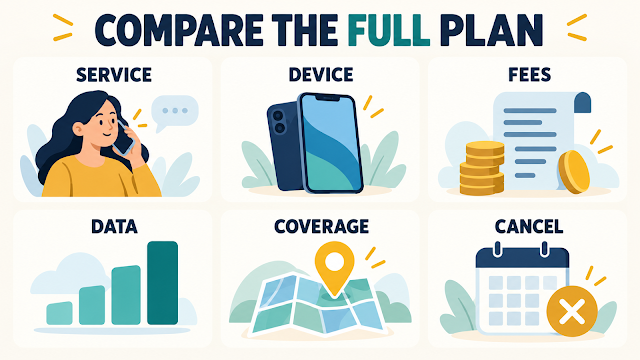 |
Calculate the total monthly and upfront cost before deciding between prepaid and postpaid. |
4. Compare the real monthly cost
Do not compare only the largest number shown in an advertisement. Build the monthly total from every component:
service price + device payment + taxes and fees + protection + add-ons − confirmed discounts
Also list upfront costs separately:
- activation or connection charge;
- SIM charge, if any;
- device down payment;
- sales tax on a device;
- deposit;
- accessories; and
- the first prepaid refill or prorated postpaid charge.
The FCC’s Broadband Consumer Labels apply to covered mobile broadband plans and are designed to display information such as monthly price, introductory terms, additional charges, data allowances, and performance. Look for the label near the plan offer and save a copy with the order confirmation.
5. Treat “free phone” and trade-in promotions carefully
A promotional phone may be provided through credits spread across many monthly bills rather than as an immediate price reduction. If you cancel, change to an ineligible plan, or fail to satisfy trade-in requirements, remaining credits may stop while the device balance remains due.
Before accepting a device promotion, write down:
- full retail price;
- required down payment;
- installment length;
- monthly device charge;
- monthly promotional credit;
- eligible plan requirement;
- trade-in model and condition requirements;
- credit start time; and
- amount due if service ends early.
A less expensive prepaid plan with your existing phone may cost less overall than a postpaid plan chosen mainly for a promotion. The opposite can also be true for an eligible multiline household that needs the included features. Do the full calculation.
6. Check coverage and data rules separately from price
Two plans using the same broad network may not provide identical terms. Review:
- coverage at home, work, school, and regular travel routes;
- high-speed data amount;
- what happens after the allowance is reached;
- whether data can be slowed during congestion;
- mobile-hotspot allowance and speed;
- domestic roaming;
- Canada and Mexico use;
- international calling and texting; and
- video-streaming limits.
Do not assume “unlimited” means every type of data always runs at the highest available speed. Read the plan label and detailed terms.
7. Confirm that your existing phone is eligible
Plan eligibility and device compatibility are separate questions. Before buying either type of service, verify that the phone is unlocked and passes the carrier’s official IMEI check.
Our Korean Galaxy S24 did not pass the Spectrum eSIM path checked at the store, but it was later activated at T-Mobile using eSIM. Read our full foreign-phone compatibility checklist before paying for a U.S. plan.
8. Questions to ask in the store
“Is this prepaid or postpaid?”
“Will you run a credit check?”
“What will my normal monthly total be after all promotions?”
“Which charges will appear on the first bill?”
“Does this price require autopay or multiple lines?”
“What happens to the phone balance if I cancel?”
Ask the employee to show you the final order summary and the applicable plan label. Take a photo or request a printed copy before approving the account. Do not provide a Social Security number, identity document, or payment information to an unverified website or caller.
9. Check the first bill or renewal amount
For prepaid, confirm the renewal date, required balance, autopay amount, and what happens if payment fails. For postpaid, compare the first bill with the order summary. The first bill may look different because of proration, activation timing, delayed discounts, equipment charges, or add-ons.
If the amount is higher than expected, do not guess why. Open the detailed bill and identify each line. Ask the provider to explain any item that was not included in the written estimate. Our broader guide to hidden costs of living in the U.S. explains why promotional prices and recurring add-ons should be recorded separately.
If your first postpaid bill is higher than expected, use our first U.S. phone bill checklist to separate prorated service, one-time fees, add-ons, taxes, and delayed credits before contacting the carrier.
Frequently asked questions
Is prepaid always cheaper than postpaid?
No. Compare the same number of lines, data, hotspot use, device cost, discounts, fees, and features. Prepaid can be cheaper in many situations, but not automatically.
Does prepaid always avoid a credit check?
Many service-only prepaid offers do, and Verizon explicitly states that its current prepaid service has no credit check or deposit. Confirm the exact provider and offer, especially if you are financing a device.
Does a postpaid phone plan build credit?
Do not assume that ordinary on-time payments will build a major credit score. Reporting practices can vary, and unpaid accounts may be sent to collections. Choose the plan for its service and cost, not an unsupported credit-building promise.
Can I use eSIM with both prepaid and postpaid?
Possibly. It depends on the carrier, exact device, account type, and activation process. Check the IMEI and eSIM eligibility before purchasing.
Can I keep my U.S. number when changing plans?
Usually you can request a number transfer between eligible U.S. services. Keep the old account active and obtain the correct account number and transfer PIN before starting.
The bottom line
Prepaid can be a practical first step when you already own a compatible phone, want predictable spending, or lack established U.S. credit. Postpaid may make sense when its multiline structure, financing, coverage, or included features provide enough value to justify the account requirements.
Whichever you choose, compare the written monthly total, upfront charges, device obligation, data rules, and cancellation consequences. A plan type is not a guarantee of a good deal.
Sources
- Federal Communications Commission: Communications Marketplace Report
- Verizon: Prepaid Plans and Service FAQs
- Federal Communications Commission: Broadband Consumer Label Fact Sheet
- T-Mobile: Bring Your Own Device Guide
- CTIA: Consumer Code for Wireless Service
This article provides general educational information. Plan prices, credit checks, deposits, discounts, device promotions, data treatment, coverage, and eligibility can change by provider, location, account, and date.