Information checked October 20, 2026. Bank and credit-union fees, waiver requirements, transfer methods, processing times, and overdraft policies vary by institution, account, transaction, and state. Always use the current fee schedule and deposit agreement for your own account.
 |
| An opening deposit, minimum-balance condition, and monthly service fee can appear together, but they do not mean the same thing. |
When we opened U.S. accounts at Bank of America and Navy Federal Credit Union, both institutions asked us to put money into the new accounts. The amounts were different. I remember an amount of roughly $300 at what I believe was Bank of America, but I no longer remember the exact product or wording well enough to present that figure as the bank’s current rule.
That uncertainty reveals the real beginner problem. Was the money a minimum opening deposit, a balance that had to remain in the account, or an amount needed to avoid a monthly fee? Those are three different conditions, even though they can sound almost identical during an account-opening conversation.
We later paid a fee when sending money internationally. We also had accounts at two institutions but did not initially know how to make a wire transfer between our own accounts. The labels—ACH, wire, Zelle, transfer, remittance—looked like different names for one action. They are not.
If you are still preparing the documents for your first account, begin with our U.S. bank-account guide for newcomers. This article starts after the account options are in front of you and focuses on the costs hidden inside the fee schedule.
Four similar-looking terms that mean different things
| Term | What it usually answers | Question to ask |
|---|---|---|
| Minimum opening deposit | How much must be deposited to open or fund the account? | Can I use or withdraw this money after the account is active? |
| Minimum balance | What balance must be maintained under the account’s stated calculation? | Is this a daily balance, average balance, or combined balance? |
| Monthly maintenance fee | What recurring charge may apply for maintaining the account? | Which actions or balances waive the fee? |
| Available balance | How much the institution currently shows as available for transactions? | Are any deposits on hold or transactions still pending? |
The CFPB advises consumers who are comparing accounts to ask whether a minimum opening deposit is required and how much it is. It separately explains that monthly fees may be waived through conditions such as maintaining a specified balance or receiving qualifying direct deposits. One amount does not automatically satisfy every condition.
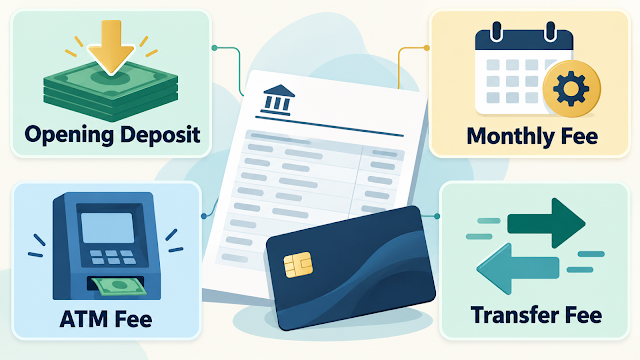 |
| Check the opening requirement, recurring fee, ATM network, and transfer method separately before choosing an account. |
1. A minimum opening deposit is not automatically a fee
A minimum opening deposit is money placed into the account, not necessarily money paid to the institution. If an account requires $25 to open and the $25 becomes part of the account balance, the institution has not necessarily charged a $25 opening fee.
But do not assume the deposited amount can immediately be removed without consequences. The account may have a separate minimum-balance rule, a monthly-fee waiver, a hold on a new deposit, or an early-closing condition. Ask for the account-opening disclosure and fee schedule before treating the opening deposit as the complete cost.
Our memory of approximately $300 is useful only as a personal reminder to ask better questions. We cannot now verify whether it was the formal opening minimum, a recommended initial funding amount, or another account-specific condition. It should not be used as a current Bank of America requirement.
2. Monthly maintenance fees may have several waiver paths
A bank or credit union may charge a monthly maintenance or service fee. According to the Consumer Financial Protection Bureau, the institution must disclose the fee when the account is opened. Some accounts waive it when the customer maintains a required balance, receives qualifying direct deposits, or meets another stated condition.
The word “monthly” does not tell you how the waiver is measured. Depending on the account, the institution may examine a daily balance, an average balance, a combined balance across linked accounts, direct-deposit activity, age or student eligibility, or another requirement. Read the exact calculation rather than assuming that one large deposit near the end of the month repairs every earlier day.
Also separate the label “free checking” from “an account whose monthly fee can be waived.” The CFPB explains that an account advertised as free or no cost cannot impose a monthly service fee or a minimum-balance fee, although other charges—such as certain ATM, overdraft, stopped-payment, or check-related fees—may still exist.
3. Minimum-balance wording can change the result
These phrases can look interchangeable but may produce different outcomes:
- Minimum daily balance: the balance may need to remain at or above the threshold each day.
- Average daily balance: daily balances may be added and averaged over a stated period.
- Combined balance: qualifying balances across specified linked accounts may be counted together.
- Direct-deposit requirement: only qualifying electronic deposits may count, and ordinary transfers may not satisfy the condition.
Do not guess based on the app’s current balance. Download or save the disclosure that defines the requirement, note the statement-cycle dates, and set a low-balance alert above the threshold when the institution offers one. The FDIC recommends reviewing the deposit agreement and fee schedule and asking about alerts that can warn customers before they fall below a required balance.
4. An out-of-network ATM can create two separate charges
An ATM with another company’s name may be outside your bank or credit union’s network. The CFPB explains that both your institution and the ATM owner may charge a fee. A screen showing one surcharge does not guarantee that a second account fee will not appear later.
Before withdrawing cash:
- use the official app’s ATM locator;
- check whether the location is in-network;
- read the ATM’s surcharge notice before continuing;
- find out whether the account reimburses any outside-ATM fees; and
- review the posted transaction afterward.
An ATM inside a familiar grocery store or pharmacy is not necessarily part of your financial institution’s network.
5. Overdraft and NSF are related but not identical
An overdraft generally occurs when a transaction exceeds the available funds and the institution pays it anyway. A nonsufficient-funds, or NSF, situation generally involves a transaction being returned or declined because the account lacks enough money. The exact labels, fees, grace amounts, and coverage vary.
For one-time debit-card purchases and ATM withdrawals, a bank generally cannot charge an overdraft fee unless the consumer affirmatively opted into that form of overdraft coverage. However, the CFPB notes that checks and recurring electronic payments can follow different rules. Declining debit-card overdraft coverage does not guarantee that every possible negative-balance event is fee-free.
We have not paid an overdraft or NSF fee, so this is researched guidance rather than our recovery story. A practical prevention routine is to keep a buffer, turn on low-balance alerts, track pending and recurring transactions, and ask whether linked-account overdraft protection itself has a transfer fee.
6. ACH, wire, and Zelle are not interchangeable
| Method | Typical use | What to verify |
|---|---|---|
| ACH transfer | Electronic transfers through the Automated Clearing House network, including many direct deposits, bill payments, and external-account transfers | Direction, verification process, amount limit, delivery time, and any fee |
| Wire transfer | Domestic or international bank-to-bank transfer, often used when speed or finality matters | Sending and receiving fees, cutoff, exact recipient instructions, and recall limitations |
| Zelle | Person-to-person payments through participating institutions | Which email or phone number is enrolled and which account receives the payment |
The CFPB defines ACH as an electronic transfer across the Automated Clearing House network. It separately defines a wire transfer as a way to move funds between accounts domestically or internationally. Availability, price, timing, limits, and error procedures are not identical.
When we had two U.S. bank accounts, we did not initially know how to wire money between our own accounts and therefore did not try. Depending on the institutions, an external ACH transfer may be the more ordinary account-to-account option, but the user must still check limits, verification, delivery time, and fees. Zelle is a separate service. Our guide to using Zelle with two bank accounts explains why one phone number or email address does not automatically route payments to every account you own.
7. International transfer cost is more than the visible fee
We have paid a fee for an international money transfer. The fee was visible, but the broader lesson is to compare the complete result, not only a headline such as “low fee” or “free transfer.”
For a covered remittance transfer, the CFPB explains that the provider generally must disclose fees and taxes it collects, the exchange rate when applicable, certain third-party fees, and the amount expected to reach the recipient. The recipient may still face disclosed foreign taxes or other permitted deductions in some situations.
Before confirming an international transfer, write down:
- the amount leaving your account;
- the provider’s transfer fee;
- the exchange rate;
- known intermediary or receiving charges;
- the amount expected to reach the recipient;
- the expected delivery date; and
- the cancellation and error-reporting instructions.
A cheaper stated fee can still produce a worse result if the exchange rate or receiving-side deductions reduce what arrives.
8. Smaller service fees are easy to overlook
The fee schedule may also list charges for cashier’s checks, stop-payment requests, paper statements, replacement cards, account research, deposited items that are returned unpaid, check orders, dormant accounts, early account closure, expedited delivery, or special transfers. Not every institution charges every fee.
Do not create a long list from memory and assume it applies to your account. Search the disclosure for the services you actually expect to use. A newcomer who rarely writes checks but frequently sends money abroad should compare different lines than someone who uses cash and outside-network ATMs every week.
Bank charges are only one part of the newcomer budget. Our guide to hidden costs of living in the United States shows how similar pricing gaps can also appear in housing, utilities, phones, shopping, transportation, and healthcare.
A ten-minute fee-schedule review
- Confirm the exact account name. Similar accounts at the same institution can have different conditions.
- Find the opening deposit. Separate the amount used to fund the account from any true opening fee.
- Find the monthly fee. Record every waiver method and how the qualifying balance or deposit is measured.
- Check ATM access. Locate the network, institution fee, operator surcharge, and reimbursement policy.
- Read overdraft choices. Identify what you have or have not opted into and what still applies to checks, ACH, and recurring payments.
- Compare transfer methods. Check external ACH, domestic wire, international transfer, and person-to-person payment limits separately.
- Search for occasional services. Review cashier’s checks, paper statements, stop payments, replacement cards, and account closing.
- Save the disclosure. Keep the version that applied when the account was opened and read later change notices.
Questions I would ask before opening the account now
If I repeated our account-opening visits, I would not ask only, “How much do I need to deposit today?” I would ask these questions separately:
- What is the minimum opening deposit?
- Does that money remain available after the account opens?
- What is the monthly maintenance fee?
- What exact actions waive it?
- How is the required balance calculated?
- Which deposits count as qualifying direct deposits?
- What happens if my available balance goes below zero?
- How can I transfer money to my other bank account without using a wire?
- What are the complete domestic and international transfer costs?
- Where can I download the current fee schedule?
I would then write the answers next to the exact account name. That last step matters because remembering “Bank of America required about $300” years later is not precise enough to identify which product, condition, or conversation produced the number.
What to do when an unfamiliar fee appears
- Open the transaction details and record the fee name, date, and amount.
- Check the fee schedule and any recent change notice for the exact account.
- Look at the transactions or balances that may have triggered the fee.
- Contact the institution through its official app, website, phone number, or branch.
- Ask for the specific contract provision and whether a correction or courtesy reversal is available.
- Save the response and adjust alerts or account settings if the charge could repeat.
A courtesy reversal is not guaranteed. If the fee appears inconsistent with the disclosure or you did not authorize the relevant overdraft service, document the issue and use the institution’s complaint process. The CFPB also accepts consumer complaints involving bank accounts and money transfers.
Frequently asked questions
Is a minimum opening deposit the same as a minimum balance?
No. The opening deposit funds the account at the beginning. A minimum-balance condition may apply later and may determine whether a monthly fee is charged. Confirm both in writing.
If I deposit enough money on opening day, will the account stay fee-free?
Not necessarily. A fee waiver may require a continuing daily or average balance, qualifying direct deposits, linked accounts, or another condition. The opening deposit alone does not prove that later requirements have been met.
Is an ACH transfer the same as a wire transfer?
No. They use different systems and can have different delivery times, costs, limits, and procedures. Check which external-transfer option your institutions provide before sending money.
Does declining overdraft coverage eliminate every possible overdraft or NSF fee?
No. The opt-in requirement applies specifically to fees for paying one-time debit-card and ATM overdrafts. Checks, recurring electronic payments, ACH transactions, and returned items can follow different rules.
Is a no-fee international transfer always the cheapest?
No. Compare the exchange rate, taxes, third-party charges, amount delivered, and delivery time in addition to the advertised provider fee.
Official sources
- CFPB: Monthly maintenance fees
- CFPB: What “free checking” means
- FDIC: Overdraft and account fees
- CFPB: Out-of-network ATM fees
- CFPB: Overdraft-fee rules and choices
- CFPB: What an ACH transaction is
- CFPB: What a wire transfer is
- CFPB: Remittance transfers and consumer rights
- CFPB: Comparing and moving checking accounts
This article provides general educational information, not individualized financial, legal, tax, or banking advice. The current disclosure, fee schedule, deposit agreement, and applicable law control your account.